She Laid Her Signed Divorce Papers on My Altar Rail at 3:00 AM — On the Ninth Night, After the Red Wax Seal and the Salt on the Courthouse Step, Her Stone-Hearted Husband Walked Back Through the Door With the Papers Still Folded in His Coat
A Personal Word from My Heart to Yours:
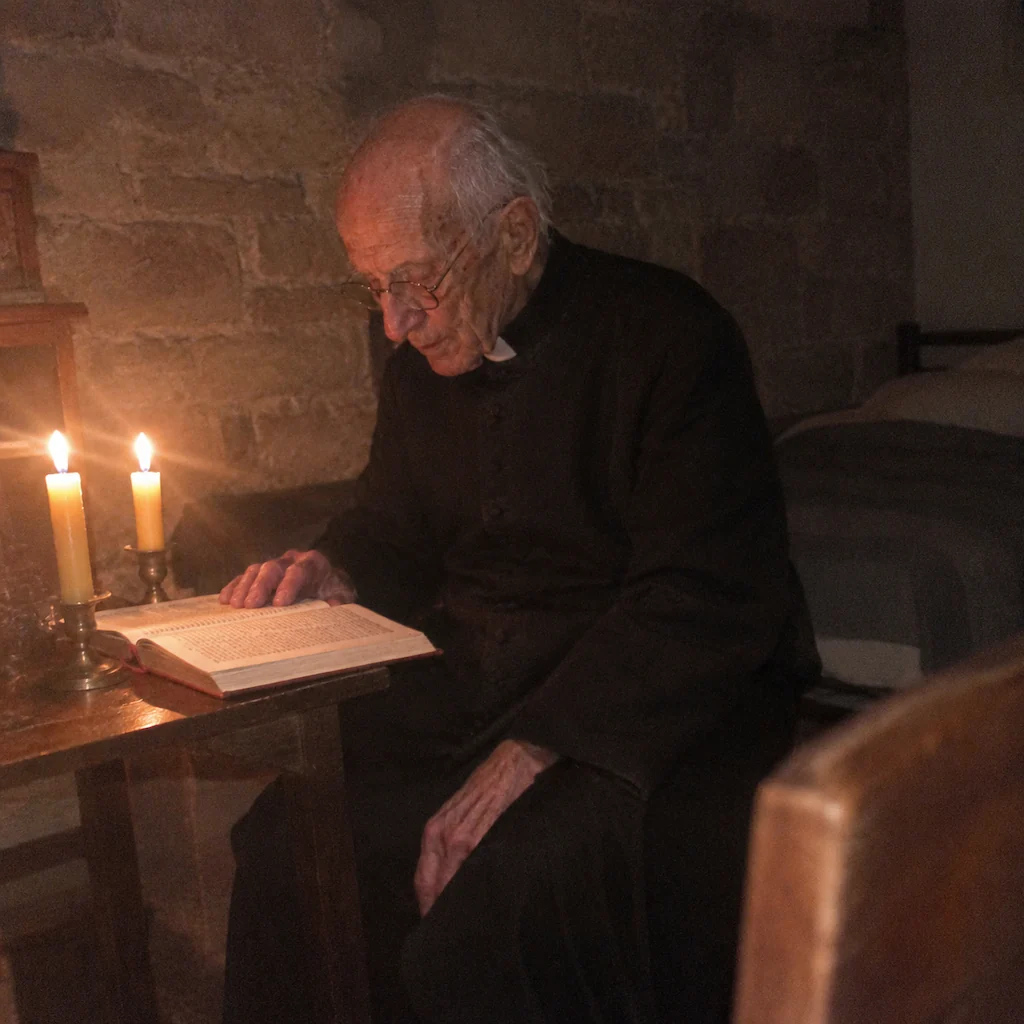
I am Father Benedict Morelli, 83 years old, custodian of the 1962 Latin Altar at St. Michael Hermitage in Clear Creek, Oklahoma. For six decades I have knelt on cold stone floors by dripping beeswax candlelight with the pre-1962 Rituale Romanum open before me, and in that time I have sat across from more wives with signed divorce papers in their purses than I can number. My hands shake now when I write, so young Brother Matteo here at the hermitage types my notebooks onto this screen word for word, and carries the parcels to the post office for me.An old priest has no business selling the treasures of the Church, and I will not. This 128-page large-print keepsake hardcover is yours as an unconditional gift at $0.00 — no discount games, no conditions, no strings. I ask only that you cover the $7.77 for the USPS Priority padded envelope and the postage stamp, so our little hermitage does not fall into debt putting these parcels into the mail.
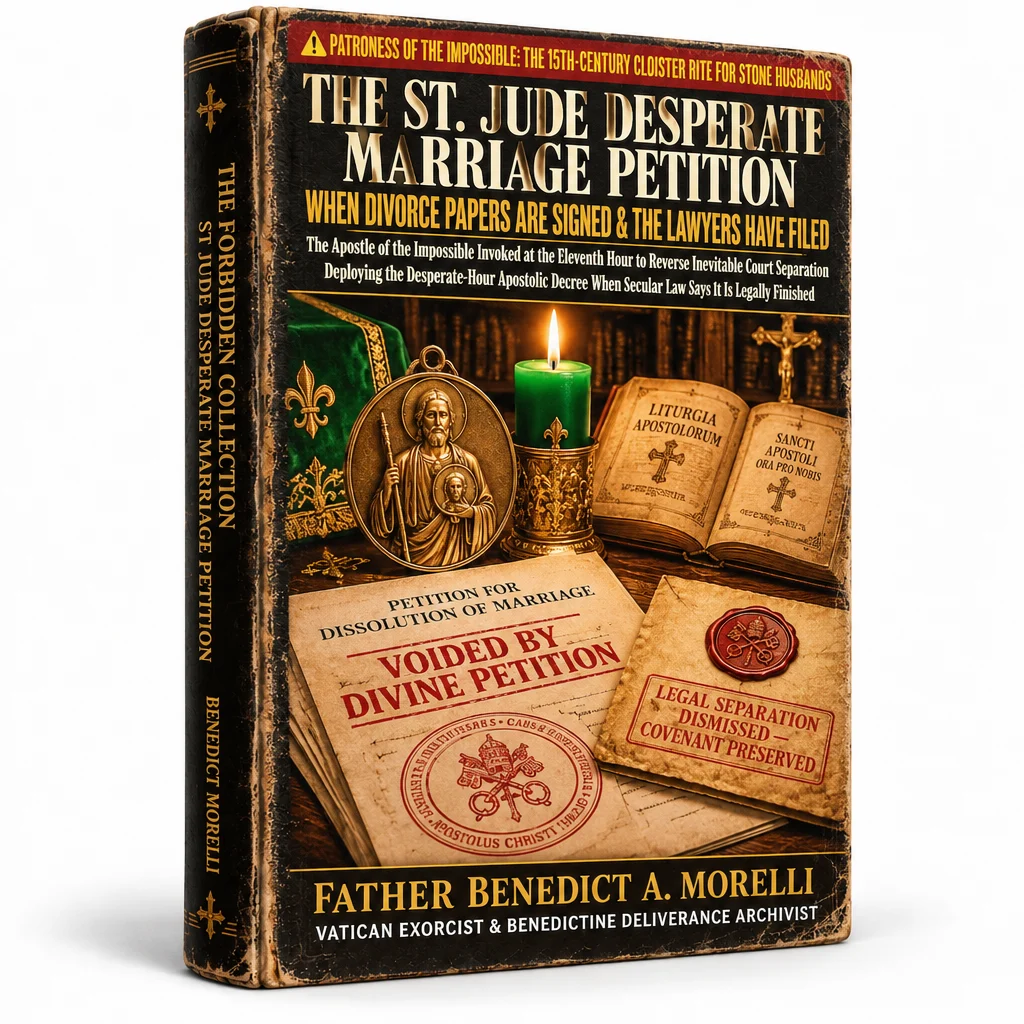
- 📖 Smyth-Sewn Flat-Lying Binding: Lies completely open and flat beside your Bible without springing shut.
- 🔍 Large 16pt High-Contrast Print: Set in big, clear type for tired eyes under dim lamplight without squinting.
- 📜 Thick Acid-Free Cream Parchment: Heavy archival pages that hold ink notes and tears without bleeding through.
Claim My Free Hardcover (Cover $7.77 USPS Postage) →
✉️ Hand-Packed and Mailed Directly From Clear Creek, OK via USPS Priority
If You Know This Silent Nighttime Agony, I Wrote Every Page for You:
- The papers are in the drawer and you can hear him breathing in the other room. He sleeps on the couch now, or he does not come home at all, and when he does pass you in the hallway he looks through you like a window. You have learned to keep your hands busy so they do not shake. You have learned not to say his name out loud, because the last three times you did, he walked out and did not come back until morning.
- Your daughter asks why Daddy sits in the truck in the driveway and does not come in. You tell her he is thinking. You tell her he is tired. You stand at the sink with the water running so she cannot hear you, and you ask yourself what kind of grandmother you will be, divorced at your age, splitting a lifetime of dishes and photographs down the middle. The shame sits on your chest like a warm wet cloth you cannot pull off.
- The attorney's office calls and you let it ring four times before you answer. There is a date now. A real date, printed on real paper, with a courtroom and a clerk and a stranger in a black robe who will say words over your marriage and make them final. You keep the envelope in the drawer under the dish towels because you cannot bear to see it on the counter, and you cannot bear to throw it away either.
- You have prayed the Rosary so many times the beads have gone smooth and nothing has moved. You have knelt until your knees ached and whispered until your throat was raw, and the house is still silent and the phone still does not ring. That is the worst of it — not the anger, but the silence. You begin to wonder whether God has simply filed your marriage away somewhere and moved on to more urgent business.
- Everyone at church has an opinion and none of them have to live in your house. One tells you to fight harder. One tells you to let him go. One tells you that you are probably better off, as though thirty years were a bad investment you should quietly write off. You smile and say thank you and go home to a kitchen with one chair pushed in and one chair pulled out, and you do not know who to believe anymore.
The Night She Brought the Papers to the Hermitage
It was a frosty late-autumn night, the kind that settles hard over Clear Creek, and she came up the gravel path to the hermitage with her coat pulled tight and a manila envelope pressed flat against her ribs. I had the kitchen stove banked low and the kettle on, and I remember the frost silvering the window glass while she sat down and could not make herself open the envelope for a long while. When she finally did, she laid the signed divorce papers on the table between us, and her hands were so steady it frightened me more than trembling would have.
Her husband of thirty-one years had signed them without a word. He had not raised his voice, she said — that was the terrible part. He had simply come home, set the papers on the counter, poured himself a glass of water, and gone to bed. For eleven weeks he had not looked at her. He slept in the back room. He ate standing up. She had cooked his favorite meal on a Sunday and he had carried the plate to the sink and scraped it off without a word, and she had stood there with the serving spoon still in her hand and understood that she was living with a stone.
She had done everything the world tells a woman to do. She had begged. She had gone quiet. She had suggested a counselor, and he had laughed at her. She had asked the parish for prayers, and one woman told her to let him go and another told her she must have done something, and she had come home from that conversation and wept in the car with the engine running so the neighbors would not hear. Her mother had prayed St. Jude all through the war, she told me, and she had been praying him now for months, and she was ashamed to admit that she had begun to feel the saint had turned his face away.
I looked at the date on those papers and I looked at the wedding date she had written on a scrap for me, and I told her plainly that I would not tell her the marriage was saved, because I am a priest and not a fortune-teller. What I told her was this: the Church has an old, half-forgotten way of laying a desperate marriage before St. Jude, and it has been used by wives in worse rooms than hers. She looked up at me then, and I saw the first thing I had seen in her all night besides fear. I saw hunger.
⚠️ The 1933 Rescript Nobody Preaches About Anymore
In 1933, in the thick of a decade that broke households apart, a rescript came down concerning the desperate petitions brought to St. Jude — the apostle of hopeless cases, the one whose name pious Catholics whisper when every other door has closed. The old directive was not complicated and it was not fashionable. It concerned a wife who had exhausted every human remedy: the petition was to be written, sealed, and buried in symbol, so that the thing asked for was placed under weight and under patience rather than under argument. Ninety-four is the number the old records attach to this form of petition, and the seal is its sign — because a seal means the matter has been handed over, and a hand that has handed something over no longer has to clutch it.
The Scripture that anchors it is Jude 1:22, where the apostle writes of souls who must be reproved and pulled from the fire, and of others who must be handled with mercy and fear. Any wife living beside a stone-hearted husband knows exactly which of those she is dealing with. The old rite understood something modern men have forgotten: that a hardened heart is not a debating partner. It is a soul in danger, and souls in danger are not argued out of the fire. They are pulled out, and pulling is done on the knees, in the dark, with the name of a saint on the lips.
And so the practice was never loud. It was done by candlelight in kitchens, by women with dish towels over their shoulders and court dates on the calendar. The wedding date written backward, because a marriage is traced back to its beginning and not forward to its ending. The paper folded three times toward you, because the petition is drawn inward to the heart and not flung outward in anger. The red wax and the thumb pressed into it, because a seal is a claim of ownership — this marriage belongs to God and not to a clerk. The heavy stone from your own yard, because the thing must be buried under weight and left there. And the salt on the courthouse step on the ninth night, because salt is the old sign of covenant, and the Church has never been shy about claiming a doorstep for Christ.
The Ninth Night and the Salt on the Courthouse Step
She did it exactly as I laid it out, and she did it badly at first, and I told her that was fine. Her first square of paper was crooked. Her wax ran. She wrote the wedding date backward and got a number wrong and had to begin again, and she wept over the kitchen table at midnight like a girl. But she kept at it, night after night, and on the fifth night she told me something had shifted in her, and it was not in him. She had stopped rehearsing arguments in the shower. She had stopped checking the driveway. The papers went into the drawer, the crucifix went on top of them, and the black cord went around the handle, and she told me that tying that cord was the first peaceful thing she had done in four months.
On the ninth night she drove to the courthouse in the dark with a small paper twist of blessed salt in her coat pocket. There was frost on the steps and no one around but a streetlamp and a stray cat, and she stood there feeling foolish and eighty years old and twenty-three years old all at once. She said his baptismal name out loud, once, the way I told her — not his angry name, not the name she had been shouting in her head, but the name the priest had spoken over him at the font when he was a small boy in a white garment. Then she let the salt fall on the step and went home and slept without dreaming.
He came through the door the next evening while she was at the stove. She heard the truck and did not turn around, because she had learned not to watch the driveway. He stood in the kitchen doorway a long time. Then he said her name — her name, for the first time in months — and when she turned, he was holding the papers, still folded, still in his coat, and he had not signed anything new and he had not filed anything and he did not know how to say what he had come to say. He said, I don't want to do this. He said it like a man setting down something heavy. They stood in that kitchen and wept, and the supper burned, and neither of them cared.
I am not going to tell you that the ninth night is a machine, because it is not. I am telling you what I witnessed with my own eyes at eighty-three years of age, and I am telling you what the old rescript has done in more kitchens than mine. The papers went into the fire that winter. She still keeps the stone from her yard on the windowsill above the sink, and when I last saw her she touched it the way a woman touches a wedding ring. St. Jude did not make her husband a different man. He pulled a soul out of the fire, and he did it on the ninth night, and he did it for a wife who had run out of everything but a candle and a name.
Inside Your 128-Page Hardcover: The 7 Sacred Protocols
- Protocol I — Write the Wedding Date Backward on a Square of Paper
- Protocol II — Fold It Three Times Toward You
- Protocol III — Seal It in Red Wax and Press Your Thumb Into the Wax
- Protocol IV — Place the Sealed Paper Under a Heavy Stone From Your Own Yard
- Protocol V — Let One Drop of Candle Wax Fall on the Seal
- Protocol VI — Put the Divorce Papers in a Drawer, Lay a Crucifix on Top, and Tie a Black Cord Around the Handle
- Protocol VII — The Ninth Night: Salt on the Courthouse Step and the Baptismal Name Spoken Once
“St. Jude, apostle of Christ and friend of the hopeless, I come to you because I have run out of words that work. I place this marriage before you, the marriage begun at an altar and not in a courtroom, and I ask you to pull my husband out of the fire as Scripture says you have done for others. I write the date backward and fold it toward my heart, and I seal it in wax as a claim — this man is baptized, this man is claimed, and no paper on earth has authority over a soul marked at the font. I bind these divorce papers under the Cross of Christ and I tie the cord shut, and I will not open that drawer again in fear. On the ninth night I will speak his baptismal name once upon the courthouse step, and I will leave the rest in the hands of God, who counts every tear and forgets no covenant. Amen.”
Every night at 3:00 AM I rise here at St. Michael Hermitage and keep the vigil with the beeswax candle and the old Latin prayers, and I name before God every wife who has written to me with papers in her purse. When you wake in the dark and cannot sleep, you are not the only one awake — you are joined to a hermitage in Oklahoma and to thousands of Catholic women across this country praying the same nine nights. Write to me, and young Brother Matteo will put your name on the list beside my candle.
Send My Free Keepsake Hardcover ($7.77 Postage) →
✉️ One-Time $7.77 Post Office Stamp · Zero Subscriptions · Mailed via USPS Priority
Words From Those Who Held These Pages in the Dark:
“My wife of thirty-eight years had the papers drawn up and I was too proud to say a word against it. It was she who found this book, and she asked me to do Protocol VI with her — the crucifix on top and the black cord around the drawer handle. I am not a man who cries, but I could not tie that cord without weeping. We did the ninth night together and we are still in the same house, and I thank St. Jude and Father Benedict for it.”
“I did the wedding date written backward on a square of paper and folded it three times toward me, and I want to tell you plainly that the folding was what broke me open. Thirty-one years came back to me in that one small motion. My husband has not moved back home yet, but he calls now, and he asks how I am, and last Sunday he came to Mass and sat in the back. Father Benedict writes like a man who has sat in the same kitchen.”
Questions You May Be Asking Me:
Because I am a priest at the end of his life and I will not sell the consolations of the Church like a merchant. The book is an unconditional gift at $0.00 — there is no discount, no hidden charge, and no obligation of any kind. The $7.77 is simply what the post office charges us for the USPS Priority padded envelope and the stamp, and I ask you to cover it only so that our small hermitage in Clear Creek does not go into debt mailing parcels to the wives who need them.
It is a real physical hardcover — 128 pages, 6 by 9 inches, smyth-sewn so it opens flat and will not shed pages, printed in 16-point large print on cream paper for older eyes and dim kitchen lights. Young Brother Matteo wraps each one in the padded envelope himself and carries the sack down to the post office, and he prays over the parcels as he goes. You will be able to hold it, mark it, and leave it on your nightstand.
I will not lie to you, and I will not sell you a guarantee that Heaven has not given me the authority to sell. What I can tell you is this: the nine nights are not a lever to force your husband's will, and they are not a test you can fail. They are a way of putting a weight down that you were never strong enough to carry, and of placing your marriage under the Cross instead of under a court date. I have seen stone hearts move. I have also seen wives find a peace that carried them through a divorce they did not choose, and that peace was not a lesser miracle. Do the protocols, speak the decree, and then sleep — because the saint does his work while you are asleep, and you have been awake far too long.
Father Benedict Morelli
Claim My Free Hardcover Now ($7.77 Postage) →
All hardcovers are printed in the United States and mailed via USPS Priority Mail.